

Share
As a turbulent economic 2025 comes to an end, delegates at Ontario Regional Council (ORC) gathered at the Sheraton Hotel in Toronto with a unified message: Canadian workers are not facing this trade war alone. They have Unifor firmly in their corner.
Unifor Ontario Regional Director Samia Hashi delivered an unflinching assessment of the challenges workers face as tariffs rise, jobs are lost, and corporate greed intensifies.
“The moment we’re in is not an easy one,” she said.
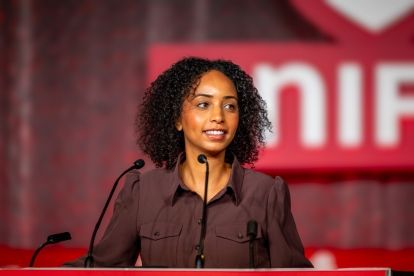
“Every single day, I hear from members who are worried. Worried about their jobs. Worried about their mortgages. Worried about whether Ontario’s economy will still have a place for them in the future.”
Hashi highlighted workers from forestry towns, auto plants, hospitals, and telecom centres—each fighting to protect their livelihoods and communities.
“Ontario can’t be strong without a strong North,” she said. “We are not going to let these communities be left behind.”
On the crisis in health care, she stressed, “You cannot fix Ontario without fixing health care, and you cannot fix health care without respecting the workers who hold it together.”
Hashi also condemned the Ontario government’s refusal to declare Intimate Partner Violence (IPV) an epidemic, making Ontario one of the few provinces not to do so.
“Declaring IPV an epidemic is not symbolic. It is the first step in unlocking real resources, supports, and accountability,” she said.
“[Survivors] deserve more than empty words. They deserve action.”
She closed with a message rooted in Unifor’s collective strength.
“Ontario is strong because you are strong,” she said.
“And this union is powerful because you are powerful. Because we are Unifor. We are a fighting union. And when we fight, we win.”
Unifor National President Lana Payne addressed council with a fierce and militant address outlining the profound challenges facing workers across the country. She reaffirmed Unifor’s commitment to solidarity, resistance, and defending Canadian jobs amid U.S. President Donald Trump’s escalating tariffs.

“[Corporations] can bend a knee to Trump, but this is what I know, this union will be bending to no one,” she said.
“Not while we have breath. Not while we have the capacity to fight. Not while we have the kind of special solidarity needed to win for working people.”
Payne detailed the hardships faced across multiple sectors—from auto and forestry to aluminum, manufacturing, and transportation, among others. Plant closures, lockouts, and increasingly hostile governments have left workers and their families carrying the burden of an international trade conflict they did not create. The one constant, she said, is that Unifor members continue to show up for each other.
Her sharpest rebuke was reserved for Stellantis, which she said violated commitments in the Brampton collective agreement, creating a “massive credibility problem.”
“Auto companies who are not standing up for the Canadian auto industry need to understand, Canadians see you not standing up for your Canadian workforce,” Payne warned.
“It is disgraceful. They owe Canadian workers—the people who, with their sweat and skill, have been there for their companies, day in and day out. Through a global financial crisis, through a global pandemic. In return, we have seen the worst in corporate culture.”
Payne underlined that Unifor is often the only consistent voice pushing governments and corporations to protect Canada’s industrial economy. She called for substantial public and private investment across aerospace, rail, electric vehicles, housing, telecom, and forestry—arguing that Buy Canadian must also mean Make Canadian.
“This union on many days is the only counter in this trade war, the only voice for workers. And our members and Canadians are counting on us,” she said. “We are a Canadian union for Canadian workers.”
She also criticized anti-union legislation emerging in Alberta, Quebec, and Ontario. Quebec’s Bills 3 and 89, she said, threaten the Rand Formula and fundamental union democracy—a move that has galvanized Unifor activists across the country.
“This is one union that will not be obeying the laws in the province of Quebec,” Payne said, praising members who “lit a fight” in Montreal last week.
Payne highlighted the courage of workers on the front lines, including newly-organized members at Walmart, Amazon, CTV News, Cleveland Cliffs, and Local 8300 health care workers.
She closed her address with a call to action.
“Rest up,” she said. “And let’s start 2026 off with the fire we know is needed to win for working people!”
Council opens with Indigenous welcome and a call to protect Canadian jobs
The first day began with an Indigenous welcome from Elder John Laforme and powerful drumming by WalksacrossCollective.
Unifor Ontario Regional Council Chair Shinade Allder set the tone for the week.

“This is a chance to rebuild hope, to listen and learn from one another, to forge the connections that will carry us through this fight,” she said. “Nothing moves without workers in Ontario.”
National Secretary-Treasurer Len Poirer followed with gratitude for delegates’ resilience and achievements.

“ORC is always a special time for reflecting on all the difficult and great work, you the membership and our locals have achieved, all the great wins over the year,” he said.
Forestry under siege
Unifor National Forestry Council Chair Stéphane Lefebvre described the staggering pressures facing the forestry sector—two decades marked by wildfires, infestations, economic decline, softwood lumber disputes, and now Trump’s trade war.
Ontario Primary Forestry Council Chair Katrina Peterson warned that U.S. tariffs now total 45% on Canadian softwood lumber.

“The impacts have been disastrous for forestry workers and their families,” she said.
“Many rural communities and in central and northern Ontario depend on the forestry sector for their very existence. When the forest sector struggles, our rural communities suffer.”
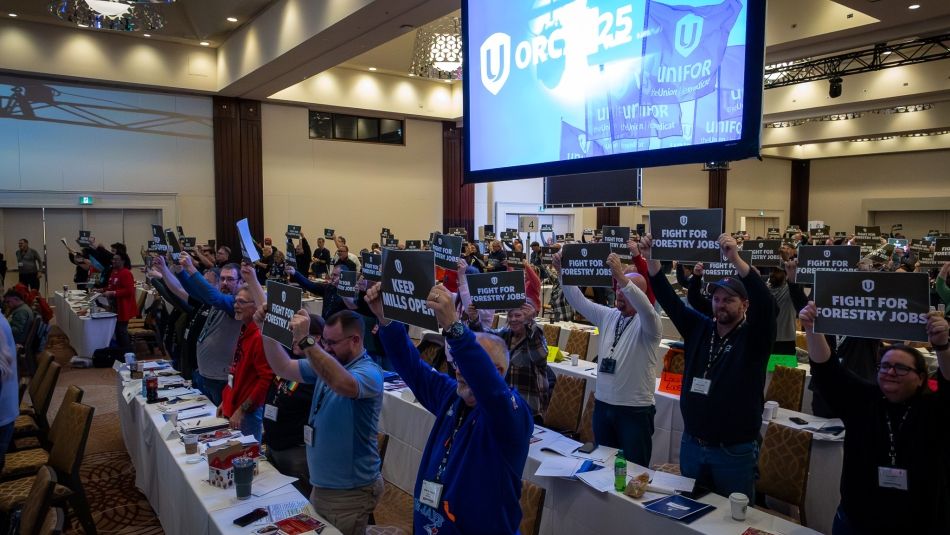
Unifor called for immediate income supports for laid-off workers and a long-term industrial strategy to rebuild demand for Canadian wood products. Delegates held signs reading “Fight for forestry jobs” and “Keep mills open.”
‘There’s no time to play safe’
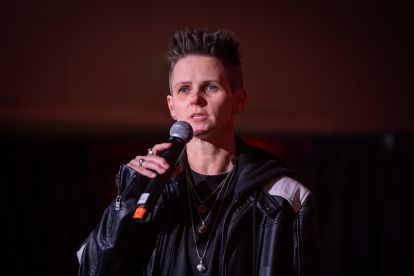
Educator and guest speaker Joanna Johnson urged unions to confront the comforting political myths that keep the public passive. Using metaphors from Wicked, she argued that unions must lead the moment, tell the truth, and “get on the broom.”
“There’s no time to play safe. There’s no time to be nice. There’s no time to play by the rules,” said Johnson.
IPV crisis takes centre stage on ORC Day 2
A panel featuring MPP Kristyn Wong-Tam, Hiatus House Executive Director Sylvie Guenther, and Unifor Women’s Director Tracey Ramsey framed intimate partner violence as a national crisis requiring immediate action.
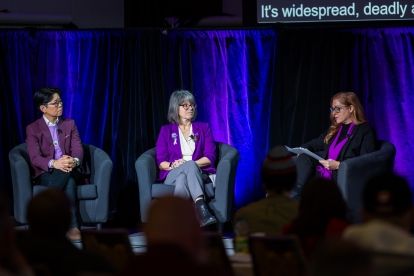
“Women are not dying because of a lack of knowledge of what needs to be done. They are dying because of our system’s lack action,” said Ramsey.
“You should not be left with those problems on your own, and a union cannot deal with it on their own without the partnership of a government.”
Unifor’s national campaign calls on governments to formally recognize IPV as an epidemic and to match that declaration with real investments in shelters, transitional housing, income supports, prevention programs, and justice systems that protect survivors rather than endanger them.
Guenther described overwhelming pressures on shelters, noting that Windsor-Essex’s 44-bed facility is supporting 74 women. Survivors need safe housing, mental-health supports, and income security.
“Trauma is a real issue for women who are coming out of a violent relationship, and it takes time,” she said. “It takes support to be able to overcome some of those things.”
Wong-Tam denounced the Ontario government’s refusal to declare IPV an epidemic, comparing the “endemic” label to saying it’s “like the mumps.”
“It flares up every now and then…let’s just manage it. That is not good enough,” she said.
“When you name a problem an epidemic, you bring to it the whole of government response at the emergency level that it deserves.”
Unifor National presented a $50,000 donation cheque to Hiatus House to help women and their children escaping violent domestic relationships to transitional housing, mental health supports, and economic stability.

Donning purple hats to symbolize support for IPV survivors, hundreds of delegates then attended a vigil across the street at Nathan Phillips Square to commemorate the National Day of Remembrance and Action on Violence Against Women and honour the 14 women killed in an act of gender-based violence at L’École Polytechnique in Montreal on Dec. 6, 1989.

ORC Chair re-elected
The ORC re-elected Shinade Allder as its chairperson and Balkar Bains for Secretary-Treasurer who will be joined on the ORC executive by Manny Cardoso who was elected as Vice-Chairperson.
Eight Members-at-Large and ORC committee members were also elected.
The national union, ORC and locals donated $150,000 to Homes for Heroes Foundation, which aims to end veteran homelessness and $13,000 was raised at the council for Jamaica hurricane relief.
ORC Day 3 focuses on fact-based journalism
The final day of the council opened with a presentation on Uniform Media Action Plan’s Fact Checked Campaign, in order to bring attention to the fight against misinformation by fact-checking information at a credible Canadian news source and be wary of social media.
“With AI-generated content flooding the internet and social media sharing of ‘information,’ the line between what’s real and what’s fake is becoming harder to see,” said Unifor Media Council Chair Julie Kotsis.
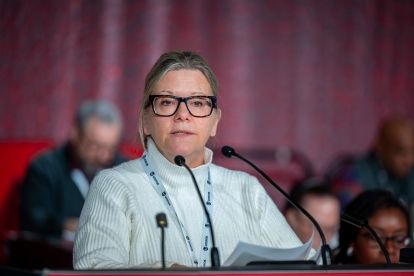
“As trust collapses, the need for credible, locally grounded journalism becomes more urgent.”
The group, Shared Bylines, followed, outlining a mentorship and scholarship program to support Black, Indigenous and journalists of colour students.
Delegates also listened to a presentation on the rapid expansion of AI in workplaces by York University professor Dr. Hannah Johnston.
She outlined how AI already shapes daily work through surveillance, scheduling systems, performance tracking, hiring tools, warehouse monitoring, call-centre analytics, and productivity software. Rather than empowering workers, these tools often increase pressure, intensify discipline, and shift accountability onto workers when systems fail.
Johnston stressed this is not just an individual privacy issue but a collective labour issue, because power comes from combining data across entire workforces.
“Data is not like this glass of water that I’m going to drink and it disappears,” she said.
“The data that’s collected about you today can be used in the future in ways that you haven’t yet imagined.”
ORC Chair Shinade Allder concluded the council with words of encouragement and thanked everyone for their solidarity.