

Share
The rapid rollout of artificial intelligence (AI) is often marketed as a new and inevitable revolution. But beyond slick marketing campaigns, this digital shift is the latest chapter in a centuries-old story about how work changes, and why collective power is essential to ensuring workers have a real seat at the table to protect their jobs, skills and work environment.
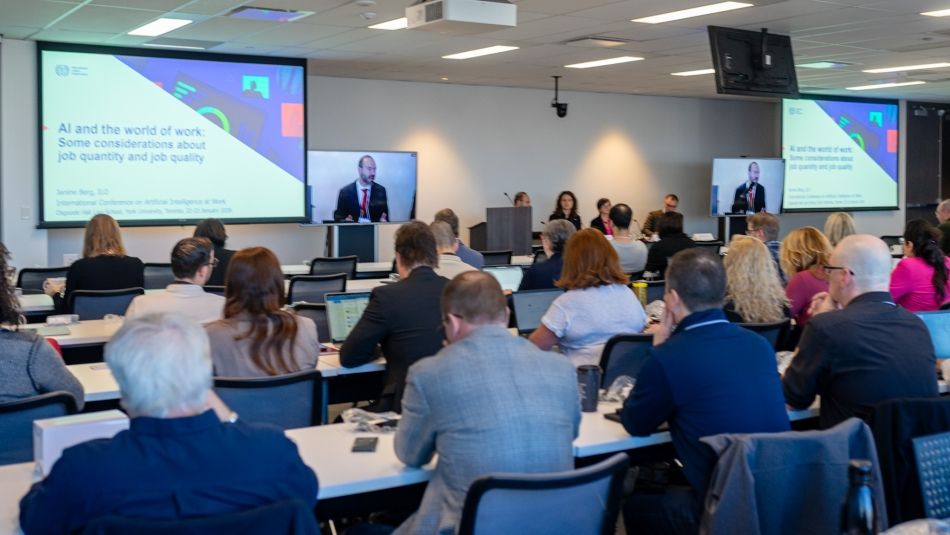
On Jan. 22 and 23, Unifor representatives joined academics and policymakers at the International Conference: Artificial Intelligence at Work, which examined how AI is being introduced into workplaces and what safeguards are needed to protect workers.
The conference aimed to move beyond simplistic “good versus evil” debates about AI, focusing instead on governance, regulation and the real-world impacts of these technologies on workers.
A central theme was the narrow way management often defines the work of employees. Janine Berg of the International Labour Organization noted that most jobs are made up of a bundle of tasks that require independent judgment, experience and human interaction, elements that are routinely overlooked in automation strategies that are simply looking to replace workers with machines.
Algorithmic management, software used to assign work, evaluate performance or issue discipline, is expanding across sectors where Unifor members work, including manufacturing, transportation, telecommunications and media. Tools that track vehicle data, keystrokes or productivity metrics can intrude deeply into workers’ privacy, often without clear limits on data storage, access or deletion.
Speaking on regulation and technology, Valerio De Stefano of Osgoode Hall Law School warned that algorithmic management leaves essential parts of work invisible while expanding unnecessary surveillance.
Speakers said applying off-the-shelf AI systems to complex jobs often fails because these tools do not capture human discretion or tacit knowledge. The process of automation drives the standardization of work through technology by deskilling jobs and makes control easier.
The conference placed today’s AI boom in an historical context, noting that technological change has long been used to shift power away from workers. In his talk on regulation and technology at work, Simon Deakin from Cambridge University traced this dynamic to the 19th-century Jacquard loom, which captured the historical knowledge of skilled workers and transferred it into the machine.
Today’s push toward AI is heavily fuelled by venture capital. Panelists said rapid workplace adoption is often driven by investor pressure rather than proven improvements to job quality or services.
Participants said constant monitoring is associated with higher stress, burnout and reduced worker autonomy.
Partial automation can also make jobs harder. When automated systems handle routine tasks, human workers are left with the most complex or emotionally demanding interactions, further eroding job quality.
Six Silberman of the University of Oxford discussed a policy blueprint co-authored with Jeremias Adams-Prassl that proposes a regulatory or negotiated floor of protections for workers facing algorithmic management.
The blueprint calls for limits on data collection, transparency around how worker data is used, bans on fully automated terminations and guaranteed human review of major decisions. It also stresses the need for union consultation and protection from retaliation.
While speakers said stronger regulation and legislation are needed, they emphasized collective bargaining as an immediate and effective tool.
“We’re going to have to rely on what we can do at the collective bargaining table,” said Unifor National President Lana Payne. “Collective bargaining gives workers a real voice right now and allows us to set guardrails as technology evolves.”
As AI and automation accelerate, the conference underscored what is at stake for workers across Canada. For Unifor, the goal remains protecting good jobs, workplace dignity and workers’ right to shape how technology is used at work.