

Share
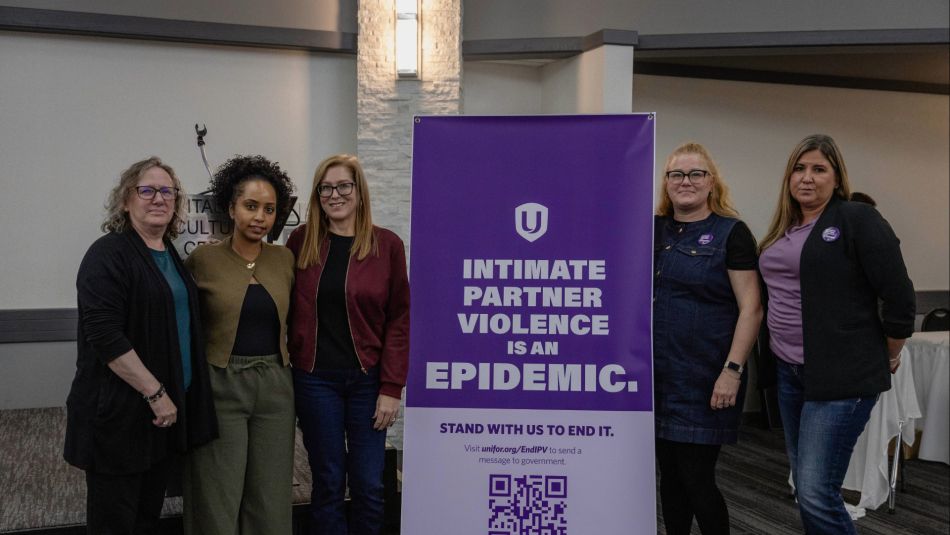
Unifor members, frontline service providers, and advocates gathered in Thunder Bay, ON, on Wednesday, November 18, for an Intimate Partner Violence (IPV) Symposium. The day was dedicated to strengthening community supports, gaining skills, and strategizing to demand that municipal and provincial governments declare intimate partner violence an epidemic.
The one-day forum was the latest in a series of symposiums that Unifor has hosted across the country. The regional events are part of a campaign to urge every province to formally recognize intimate partner violence as an epidemic and invest in the services survivors rely on to access safety and support.
Ontario Regional Director Samia Hashi welcomed delegates to the gathering and underscored the vital role that unions play in confronting intimate partner violence.
“What’s so important about these symposiums is that they give us the opportunity to learn from one another, build relationships and, most importantly, talk about what we can do next,” said Hashi.
“We know awareness is important, but we also need action. Here in Ontario, we’ve continued to push this work forward, but we still have a lot of work ahead of us.”
Women’s Director Tracey Ramsey followed with an overview of Unifor’s national campaign to declare intimate partner violence an epidemic. She highlighted the longstanding work the union has done to combat gender-based violence.
Ramsey shared the groundbreaking work that has been done to declare IPV an epidemic in New Brunswick, Nova Scotia, and Newfoundland and Labrador.
Declaring IPV an epidemic allows our healthcare and social services access to more resources to end violence, not just in acute crisis situations. This formal legislative declaration is the first step towards the enactment of provisions that are needed to ensure we are providing every level of support needed to end the violence.
“When Unifor uses our collective power we can push the needle. We need to continue for our members, for our communities and everyone who needs us to be that powerful force towards policies that can save lives,” continued Ramsey.
Throughout the morning, delegates participated in a two-part IPV workshop led by Ontario Regional Council Women’s Committee members Sarah-Kai Antanaitis and Ashley Petrie. The workshop defined intimate partner violence, equipped participants with tools to recognize the evolving dynamics of abuse and understand barriers facing survivors.
Community organization tables were also staffed throughout the day, providing participants with opportunities to connect with local agencies and learn about the frontline services available in Northwestern Ontario.
The afternoon session opened with a presentation from Shannon O’Keefe from the Ministry of the Attorney General’s Victim Witness Assistance Program. O’Keefe outlined support available through the Victim Witness Assistance Program to help individuals throughout the court process, from lead-up to the case, to the trial stage, to sentencing.
Delegates then heard directly from local frontline leaders as part of a panel with community organizations combatting intimate partner violence. The panel featured Tana Troniak Veran, Executive Director of Faye Peterson House, and Royleen Dupuis, Transitional Housing Support Program Worker at Beendigen. The panelists shared insights into the daily realities facing crisis shelters and transitional housing programs in Thunder Bay.
“The epidemic declaration would validate what we see every day in our work. Intimate partner violence is affecting far too many individuals and families, and the demand for services continues to grow,” said Troniak Veran.
The panelists highlighted the urgent need for governments to invest in adequate safe housing, culturally grounded healing services, and wraparound support.
The afternoon also featured a powerful presentation by Chyenne Panette, a survivor, advocate and researcher. She shared her experience with addiction, intimate partner violence, and the impact of stigma on people’s ability to leave abusive situations.
Panette hopes that by telling her story, both the embarrassing and unpleasant moments, she can relate to anyone who might be going through something similar, and most importantly, ensure they understand that they are not alone.
To provide delegates with an opportunity to decompress following a day of heavy conversations, the symposium concluded with a guided self-care session led by Sandy Steward of the Breathe Healing Centre.
Unifor remains committed to working alongside survivors, labour allies, and frontline organizations across Ontario and throughout the country to call on every province to officially declare intimate partner violence an epidemic and ensure survivors have access to the resources and support they need to live free from violence.