

Share
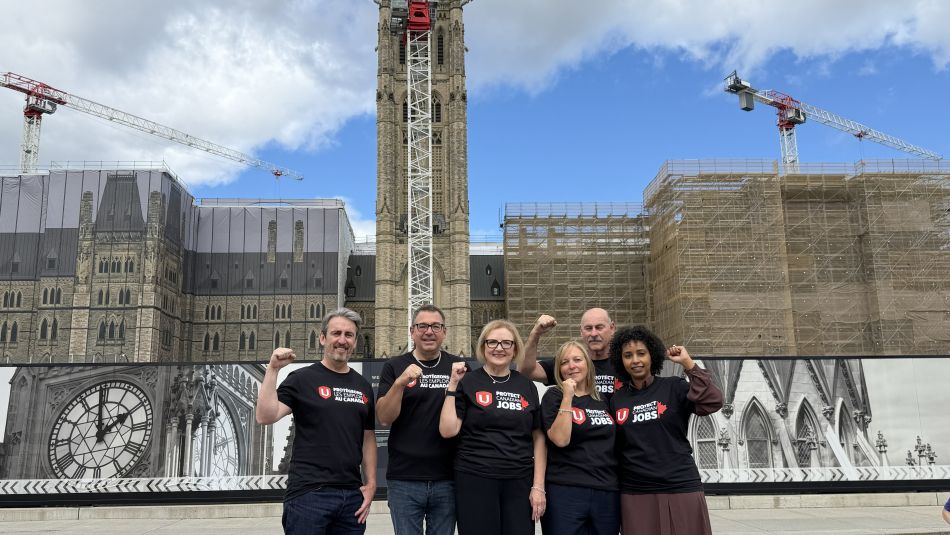
As the Canadian government walked away from trade negotiations with the United States amid escalating tensions, delegates to Unifor’s Canadian Council 2026 in Ottawa committed to intensifying the fight to protect Canadian jobs.
On the Friday of the council, Unifor National President Lana Payne welcomed the growing resolve against U.S. President Donald Trump’s tariffs and threats to key Canadian industries.
“Our union has been fighting this trade war for almost two years, and now finally we are seeing a strengthening of resolve in many places. I say, ‘Welcome to the fight.’ We are the union that is going to save Canada, and yes, protect Canadian jobs,” she said.
“As long as there is breath in my body, we, this union, will not be giving up or giving in.”
Payne applauded Canadian negotiators for rejecting a trade agreement that would have locked in damaging tariffs and concessions, stressing that future negotiations must put workers first.
“We fight for a different kind of world,” she said. “For the world we want to see for ourselves. And for the workers who will come after us.”
Council opened Friday with a territorial acknowledgement and Indigenous welcome led by professional drum dancer Donovan Gordon Tootoo. Performers from Isaruit, an Inuit-led organization in Ottawa, shared a traditional throat-singing performance.
MARCHING TO PROTECT CANADIAN JOBS
More than 1,000 delegates marched from Rogers Centre Ottawa to Parliament Hill, chanting “Protect Canadian jobs!” and waving Unifor flags.
The rally heard from Payne, Unifor Quebec Director Daniel Cloutier and Canadian Labour Congress President Bea Bruske, who pledged that the labour movement would stand together against the consequences of the trade war.
“We are drawing a line in the sand. They were elected to defend Canadian workers and their jobs and that is what we expect,” Payne told the crowd.
“We’re here to say a promise made must be a promise kept. And we are going to fight to protect Canadian jobs today, tomorrow and as long as we need to.”
PROTECTING QUEBEC’S ECONOMY
Cloutier warned that the U.S. trade war threatens manufacturing jobs, communities and Canada’s economic sovereignty. He called for stronger domestic production, supply chains and industrial policies shaped by workers.
“The time has come for us to go from firefighters to architects,” he said.
“We have to stop running from one fire to another. We have to start drawing up plans. We’ve built world-class industries in this country before. We can do it again. But first, we have to decide to do it. And we have to decide it together.”
2SLGBTQIA+ ACTIVIST SHARES HER STORY
Human rights activist Michelle Douglas shared her experience of being dismissed from the Canadian Armed Forces in 1989 because of her sexual orientation. Her legal challenge helped end the formal prohibition against 2SLGBTQIA+ people serving in the military.
Douglas invited delegates to visit Thunderhead, Canada’s national 2SLGBTQIA+ monument in Ottawa.
“If you have lived your life, maybe in the closet, maybe not using the pronouns that you really want to, maybe hiding, maybe not telling your full truth to people that you trust otherwise in your workplace—this is incredibly affirming,” she said.
NEW NATIONAL BARGAINING PROGRAM
Delegates received an overview of Unifor’s National Bargaining Program for 2026–2029, developed with input from members across the country.
The program establishes cross-sector bargaining priorities in response to the U.S. trade war, artificial intelligence, political polarization and economic uncertainty. Council approved the National President’s recommendation to adopt the Protect Canadian Jobs Bargaining Program.
“We have had great discussions on the resolutions that will chart our path forward to continue achieving the progress we know is necessary for our union,” said Payne.
Read the Canadian Council Day 1 wrap story
REGIONAL DIRECTORS REPORT ON THE FIGHT
On the second day of Council, Unifor’s three regional directors reported on campaigns and victories across the country.
Western Regional Director Gavin McGarrigle highlighted B.C.’s forestry crisis, political action in Alberta and organizing gains at Amazon’s Delta warehouse.
“The goal was never just one warehouse, it was to change an industry and to change people’s lives while growing worker power,” he said. “We take on the biggest giants in the world and win.”
Ontario Regional Director Samia Hashi highlighted campaigns to protect Canadian jobs, improve health care, recognize intimate partner violence as an epidemic and secure anti-scab legislation. She also celebrated growing 2SLGBTQIA+ and BIWOC activism.
“We are Unifor. We do not back down, and we do not do it alone,” she said.
Atlantic Regional Director Jennifer Murray highlighted victories at Munro Academy and Agropur Dairy and the successful constitutional challenge against Nova Scotia’s anti-worker Bill 148.
“I hope they tell the story of a union that showed up. A union that listened. A union that fought. A union that refused to leave anyone behind,” she said.
“And when people needed someone to fight alongside them, Unifor was there.”
STANDING TALL FOR FORESTRY
Council adopted a recommendation calling for a comprehensive strategy to strengthen Canada’s forestry sector and promote ethical Canadian supply chains and procurement policies.
“We are going to have a National Day of Action in forestry communities all over the country,” said Payne.
“We will make sure everybody [in Parliament] understands this is a crisis. And we keep going until we get what we need to support forestry workers in every community.”
Read the Canadian Council Day 2 wrap story
BUD JIMMERFIELD AWARD
The final day of Canadian Council honoured Unifor Local 114 member Cheryl Williams, the recipient of the 2026 Bud Jimmerfield Award in recognition of a decade spent making Cascade Aerospace a safer workplace.
The Bud Jimmerfield Award recognizes members who demonstrate an unwavering commitment to preventing workplace disease, injury and death. It is awarded annually to a Unifor member who has led by example and who works to make sure every worker goes home safe and healthy.
“This award is a reminder that health and safety are not just about avoiding accidents, they’re about creating a culture where people feel valued, respected, and protected,” said Williams.
“They’re about creating a culture where people feel valued, respected, and protected. As I move forward, I will continue to champion safety, to be proactive, to be prepared.”
‘BUILT HERE. FOR HERE.’
Unifor previewed “Built Here. For Here.,” a national organizing campaign aimed at non-union workers and building on organizing victories at Walmart in Mississauga, Ont., Amazon in Delta, B.C., offshore oil operations in Newfoundland and recycling depots across Quebec.
The campaign argues that amid the U.S. trade war and economic uncertainty, Canadian workers benefit from a union whose decisions, legal strategies and bargaining priorities remain in Canada.
“If your work is here, and your life is here, we believe that your union should be there, too,” said Unifor Organizing Director Justin Gniposky.
“We respect every worker standing up for their rights, regardless of their flag. But this is a campaign built for unorganized workers across Canada, the millions of people right here in Canada, who don’t have a collective voice on the job.”
English and French-language videos and a national billboard campaign will launch on Labour Day weekend with the message: “If your work is here, and your life is here, your union should be here, too.”
On the Sunday, Council adopted two of the National Presidents’ Recommendations: Protect Canadian Jobs National Bargaining Program and Promoting Ethical Canadian Supply Chains and Procurement Policies.
A number of resolutions were adopted, relating to promoting Unifor and unionized benefit providers, organizing in the energy sector, protecting Canadian Deuterium Uranium (CANDU) technical expertise, and building worker power and knowledge around AI.
Other passed resolutions included supporting the growing movement against hyperscale data centres, responsible development of Canada’s mineral resources and a Unifor action plan on equity, protecting Canada’s aviation sector against privatization and automation and protecting publicly owned and operated transit services.
Unifor also donated $10,000 to the Ten Oaks Project, a summer camp program in Ottawa and across the country for 2SLGBTQ+ youth find support, acceptance, and empowering opportunities for self-expression.
TELCO WORKERS TAKE ACTION
Unifor highlighted the newly formed Canadian Telecommunications Workers’ Alliance, a coalition with Canadian Union of Public Employees and the United Steelworkers campaigning to protect Canadian telecommunications jobs and infrastructure, including regulating AI.
“Operational control of our networks exists overseas, what about a data breach? What do we do in those cases?” said Telecommunications Council Chair Jeff Brohman at the podium.
“Laws of other countries don’t protect us. There’s no Canadian control. The funding of tax dollars and hundreds of millions have gone to these companies to build this network in Canada while they reap all the benefits and all the profits. We need to bring these jobs back to Canada, protect Canadian privacy to protect our data sovereignty and our national security. Ask to speak to a worker in Canada. If you have to call a telecommunications service provider, they’re mandated to send you back to our country.”
COUNCIL CLOSES, BUT THE FIGHT CONTINUES
Unifor National Secretary-Treasurer Len Poirier closed Council by encouraging delegates to march in Capital Pride that afternoon under Unifor’s 2026 Pride message, “Together, We Shine!”
“On behalf of the entire leadership team, I want to thank you all so much for attending, for doing the work that helps keep this union strong,” he said. “Protect Canadian jobs!”