

Share
The 2026 Unifor B.C. Regional Council (BCRC) met in Victoria from Oct. 23 to 25 with the fight to protect Canadian jobs from the U.S. trade war at the centre of the debates, reports and actions.
Friday, October 23
The council opened acknowledging the ancestral territories of the Lekwungen peoples, today known as the Songhees and Esquimalt nations. Director of Indigenous Affairs Gina Smoke asked that delegates remember that territorial acknowledgements must be more than words. Encouraging Locals to put reconciliation into practice, from commissioning local Indigenous artists to personalizing acknowledgements for the communities where union events take place.
Western Regional Director Gavin McGarrigle started the meeting off with his report. He emphasized the forestry crisis and singled out Canfor for closing its Northwood facility in Prince George, while holding almost double the production capacity in the U.S. and Europe that it has in Canada.
“We don’t want thoughts and prayers and boutique training programs,” said McGarrigle. “We want a national plan, we want money to fund it and we want a real seat at the table.”
McGarrigle also marked the deal to reopen Domtar’s Howe Sound mill, the new agreements for transit workers at Coast Mountain Bus Company and hotel workers at the Empress, and an arbitrator’s pending decision on the first Amazon contract in North America, expected mid-November.
In his presentation, Researcher Marc Hollin reviewed the unfair U.S. tariffs regime and how $3.8 billion in B.C. exports are impacted, from machinery and electronics to wood pulp and paper. Delegates unanimously adopted Western Regional Director Recommendation #1, “Protect Canadian Jobs: Holding Government to Account”. During the discussion, members singled out TransLink’s contract for trolley buses built in Poland and raised concerns about unclear country-of-origin labels in grocery stores.
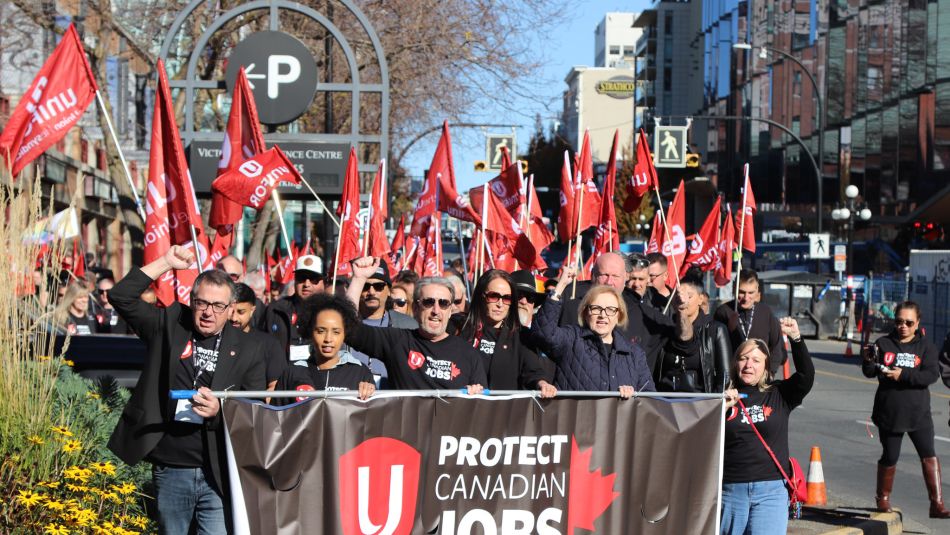
Protecting Canadian jobs was the theme of the Council’s rally later that day at the B.C. Legislature grounds.
In the afternoon, National President Lana Payne presented her report to delegates and warned that the federal government’s Bill C-39 would empower the labour minister alone to end strikes without a debate in Parliament. She vowed to continue the union’s vigorous opposition in Ottawa.
“Let’s be clear: the government's popularity doesn’t give them cart blanche to use this moment to give into big corporations and to weaken the rights of workers by undermining collective bargaining and the right to strike in the federal sectors like road, rail, aviation, marine or broadcast media,” she said “Canada used to be a beacon for trade union rights... freedom of association is guaranteed in our Charter of Rights and my friends it is damn well worth fighting for!”
Payne also used her remarks to recap the recent forestry day of action and thanked B.C. members for their participation and leadership on the front lines of the forestry fight. Her report also included updates on other campaigns across Canada, including the fight to save the Stellantis assembly plant in Brampton, Ont., where members recently delivered a 97.3 per cent strike vote.
The Health, Safety and Environment Standing Committee reported on its meeting with the WorkSafeBC board, where it pressed for transit workers to have the same washroom standards as construction workers, better heat stress protections and action on wildfire smoke.
The 2SLGBTQIA+ Standing Committee reviewed their efforts to expand Pride visibility beyond the province’s largest cities. The Council committed $400 toward replacing a Pride sign in 100 Mile House that was vandalized with slurs.
Friday’s deliberations closed with the acclamation of new member-at-large Kieran McArthur to the BCRC Executive Committee.
Saturday, October 24
BCRC Secretary-Treasurer Gord McGrath opened October 24’s meeting with the council’s financial report.
Following McGrath, National Secretary-Treasurer Len Poirier spoke and encouraged delegates to take what they learned at Council back to their workplaces and to reach members who do not normally attend union meetings. He asked delegates to keep retirees part of the union’s future, and spoke about managing members’ dues responsibly so Unifor is ready when members face closures, lockouts or picket lines.
The Black, Indigenous and Workers of Colour Standing Committee reported on its work to build leadership and fight racism in workplaces and communities across the province.
International Department Director Navjeet Sidhu shared updates from the Social Justice Fund, which delivered just over $2.28 million in grants and donations to 215 organizations in Canada and around the world in 2025. The fund’s 2026 holiday donations includes 15 food banks and women’s shelters across B.C.
Director of Organizing Justin Gniposky presented “Built Here. For Here.”, the union’s new organizing strategy. Delegates subsequently endorsed Recommendation #2, “Building on Our Organizing Victories", which calls for expanding organizing at Amazon warehouses across the Lower Mainland and B.C., empowering Amazon members trained as organizers for future campaigns.
The Workers with Disabilities Standing Committee reported on this year’s Steps for Life walk and other activities. Unifor’s updated guide to making union events and workplaces accessible to all members, the Inclusive Practices Toolkit, was also presented for delegates to download.
Unifor then presented $100,000 to Pacific Coast University for Workplace Health Sciences in Port Alberni to establish the Disability Management Leadership Scholarship, named for Bob White, founding president of the Canadian Auto Workers.
In the afternoon, Researcher Ivana Saula presented on the transit sector to set the context for Recommendation #3, “Improving Transit in B.C.”, which calls for an end to the privatization of public transit, a strict Buy Canadian mandate for TransLink and BC Transit, and voting seats for frontline workers on both transit boards.
The BCRC Political Action Committee’s presentation followed, reviewing the considerable work undertaken during the B.C. provincial election. Delegates were also given a preview of the new B.C. forestry video, followed by the adoption of Recommendation #4 calling for escalating the forestry campaign.
To end the day, the Women’s Standing Committee reported on its ongoing campaign to have intimate partner violence declared an epidemic in British Columbia. They introduced guest speaker Sarah Sherman from We’re Here For You Canada, and organization supporting survivors of sexual violence.
Sunday, October 25
Media Director Randy Kitt and Media Sector Representative to the National Executive Board Julie Kotsis opened the final day with an update for delegates on Unifor’s Fact Check campaign, which highlights the pivotal role played by news media to provide fact-based coverage of events in an era increasingly infected by AI slop and planted misinformation. Since 2023, 1,078 Unifor media members have lost their jobs to layoffs.
Researcher Graham Cox delivered a presentation on bargaining artificial intelligence and technological change. He outlined collective agreement language that protects workers, including limits on surveillance and speed-up, a real right to review and no fully automated terminations.
The Young Workers Standing Committee delivered the final committee report before closing remarks, as delegates headed home to carry the council’s work into their workplaces.
A report on the union’s Protect Telecommunications Jobs and political action work was presented by NEB member Jeff Brohman and Director of Membership Mobilization and Political Action Josh Coles respectively.
McGarrigle closed the 2026 BCRC with an energetic call to defend the movements gains and to keep hope during the coming challenges Learn more about Unifor’s campaign to protect Canadian jobs at protectjobs.ca.