

Share
Lana Payne said Unifor will not be “giving up or giving in” as the trade war with the U.S. continues to escalate.
Addressing delegates on the first day of Unifor’s 2026 Canadian Council in Ottawa, the union’s National President repeatedly returned to solidarity as the answer to efforts to divide workers.
“Our union has been fighting this trade war for almost two years, and now finally we are seeing a strengthening of resolve in many places. I say, ‘Welcome to the fight.’ We are the union that is going to save Canada, and yes, protect Canadian jobs,” she said.
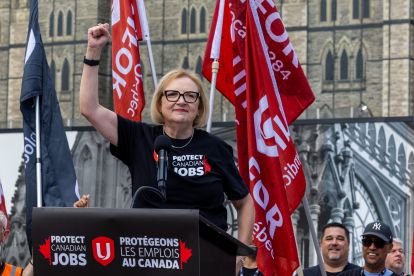
“As long as there is breath in my body, we, this union, will not be giving up or giving in.”
More than 1,000 Unifor members, local union leaders, activists and guests gathered at the Rogers Centre in Ottawa for Canadian Council from Aug. 28 to 30, renewing their commitment to protect Canadian jobs amid the ongoing U.S. trade war.
Speaking just steps from Parliament Hill, Payne warned delegates that decisions made in the coming weeks could shape Canada’s economy for generations. As a sitting member of Prime Minister Mark Carney’s Advisory Committee on Canada-U.S. Economic Relations, she applauded Canadian negotiators’ decision to walk away from a trade agreement that would have locked in damaging tariffs and concessions.
Payne called on governments to ensure workers are at the centre of Canada’s response to U.S. tariffs and protect the plants, mills, supply chains and industrial capacity that sustain communities across the country.
“This is far more than a trade war. It is a war against working people. Look at what is being attacked,” she said.
“We have no choice, but to draw a line in the sand, and fight like hell. Because it is one thing to have punishing tariffs imposed on us. It is another to agree to them. So, there was no way I was letting this go.”
She also warned Ottawa against weakening the right to strike through a review of the Canada Labour Code, stressing that the union’s cooperation with the federal government on Canada-U.S. trade would not stop Unifor from challenging it on workers’ rights.
Payne highlighted fights across the union, from forestry and auto to health care, media, transit, gaming and energy, pointing to bargaining wins with General Motors, organizing victories at Walmart and the ongoing battle for a first agreement at Amazon.
“We are the counterforce,” she said.
“We fight for a different kind of world. For the world we want to see for ourselves. And for the workers who will come after us.”
RALLYING TO PROTECT CANADIAN JOBS
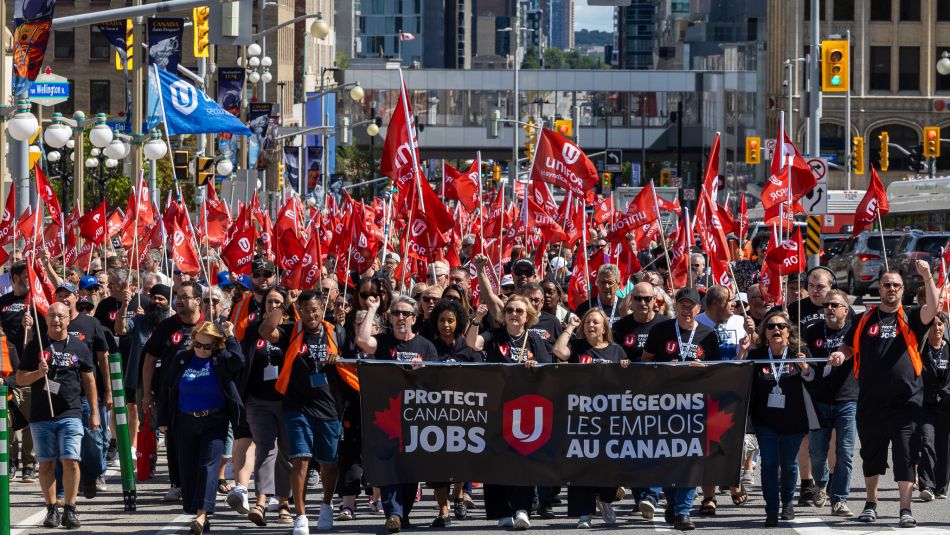
Unifor members soon after took their message directly to Parliament during a Protect Canadian Jobs rally.
Waving red Unifor flags, members called on federal leaders to defend Canadian workers and industries from U.S. tariffs and economic uncertainty.
Unifor Quebec Director Daniel Cloutier reminded the crowd to use their collective voice because “it’s you that built this country,” while Canadian Labour Congress President Bea Bruske affirmed the labour movement is standing together against U.S. President Donald Trump.

“[Politicians] need to know. We are drawing a line in the sand. They were elected to defend Canadian workers and their jobs and that is what we expect,” Payne told the crowd.
“We’re here to say a promise made must be a promise kept. And we are going to fight to protect Canadian jobs today, tomorrow and as long as we need to.”
Council opened Friday morning with a territorial acknowledgement and Indigenous welcome led by professional drum dancer Donovan Gordon Tootoo, alongside performers from Isaruit, an Inuit-led organization in Ottawa, who shared a traditional throat-singing performance.
Delegates also observed a moment of silence for Unifor members who died in the past year.
QUEBEC’S ECONOMIC FUTURE
In his speech, Daniel Cloutier warned that the U.S. trade war threatens manufacturing jobs, communities and Canada’s economic sovereignty.
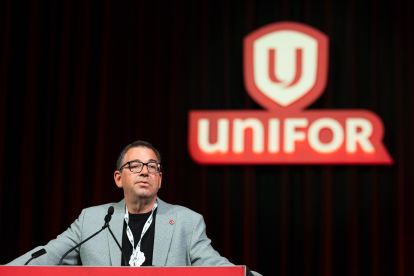
He called for stronger domestic production, supply chains and industrial policy, arguing unions must help shape the economy rather than simply react to layoffs and closures.
“The time has come for us to go from firefighters to architects,” he said.
“We have to stop running from one fire to another. We have to start drawing up plans. We’ve built world-class industries in this country before. We can do it again. But first, we have to decide to do it. And we have to decide it together.”
Cloutier said Unifor will remain politically engaged, including during the upcoming Quebec election.
“Being at the table means one thing: no longer letting others decide for us,” he said.
RECOGNIZING STRIKING AND LOCKED-OUT WORKERS
Delegates rose in solidarity with Unifor members engaged in strikes and lockouts across the country.
Local 12 President Kim Davidson spoke about 42 members at Saint-Gobain in Plattsville, Ont., who have been on strike since July 24 for fair wages and secure pensions.
“I want to thank the members of Local 12 who have stuck it out and committed to fighting this company and getting what’s right for us all,” said Davidson.
Delegates also heard from representatives of Local 1090 casino workers in the Greater Toronto Area. Approximately 100 security officers at Great Canadian Casino Resort Toronto have been locked out since July 23, while more than 900 members at Casino Ajax and Pickering Casino Resort have been on strike since July 31.
“Four years ago, we fought for the same thing,” said Samuel Ho, chairperson of the Casino Ajax and Pickering Casino Resort unit. “Now, we’re still fighting.”
In British Columbia, Local 111 President Mike McMillan, Local 2200 President Scott Walters and Local 333-BC President Stephen Bains updated delegates on disputes involving more than 6,000 transit workers fighting for fair wages and preserving dignity by improving working conditions, adequate recovery time and reliable access to washrooms.
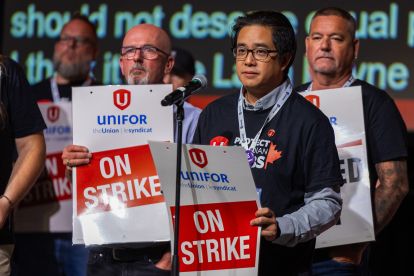
“We all work with pride to keep our buses on the road,” said Bains.
“Show up every morning at 4, to take people to work with pride, every day. What we’re seeing is a society is we’re seeing more fentanyl use at stops or on buses. While all of these working conditions are becoming unhealthier, our wages are falling further behind and our dignity is lacking.”
Local 433 members also began strike action at Veolia’s waste-to-energy facility in Burnaby, B.C., on Aug. 25. Local 433 Vice-President and Veolia workplace representative Bryan Lesko said the 37 members remain united against concessions.
“These workers do the most dangerous work of all our members in the local,” said Lesko.
“This is yet another example of a private foreign company using taxpayer dollars to the disadvantage of hard-working Canadians.”
Council also celebrated Unifor Local 195 members at Titan Tool and Die, who recently resolved their dispute after 350 days on the picket line.
“Our local stood firm for all four seasons, cold, rain, storms and heat without caving into the employer,” said Local 195 Sergeant-at-Arms Bernie Coates.
HONOURING A HUMAN RIGHTS ACTIVIST
Human rights activist and former Canadian Armed Forces officer Michelle Douglas shared her story with delegates.
Douglas began her military service as an air force second lieutenant in the late 1980s and became one of the first women to join the Canadian Armed Forces’ Special Investigations Unit.
After facing discrimination because of her sexual orientation, Douglas was dismissed from the military in 1989. She launched a legal challenge that helped end the formal prohibition against 2SLGBTQIA+ people serving in the Canadian Armed Forces.
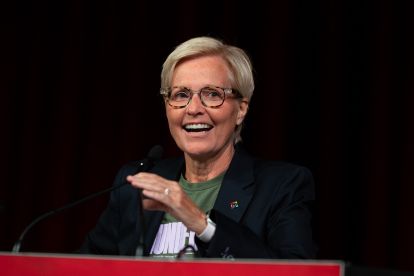
“There were 9,000 Canadians who went through this between the 1950s and the 1990s. The losses to the Canadian workplace were incalculable, so many good people who signed up to service, were lost, changed, humiliated, arrested and criminalized,” she said.
Douglas invited delegates to visit Thunderhead, Canada’s 2SLGBTQIA+ national monument in Ottawa.
“If you have lived your life, maybe in the closet, maybe not using the pronouns that you really want to, maybe hiding, maybe not telling your full truth to people that you trust otherwise in your workplace—this is incredibly affirming,” she said.
BUILDING WORKER POWER WITH A NEW PLAN
Delegates received their first overview of Unifor’s newly developed National Bargaining Program for 2026 to 2029.
Created with input from members across the country, the program sets cross-sector priorities that bargaining committees and staff can bring to contract negotiations.
Bruce Snow, retiring assistant to the National President, and Martin Lambert, assistant to the Quebec Director, co-chaired the National Bargaining Program Committee and introduced the first segment.
“This program is more than a document that we put in your kit. It’s a commitment. It’s an action plan that was made for and by Unifor members,” said Lambert.
“This is a program that is inspired by your experiences, your structure and your wins. Collective bargaining is the most powerful tool we have. This is the most powerful tool we have to protect Canadian jobs.”
Snow said this about “continuing the conversation” to share experiences in the workplaces, what is working, what’s missing and what is needed to strengthen the program.
“The success of this program depends on the knowledge, courage and the leadership in this room,” he said.
Delegates also adopted a National President’s Recommendations on defending Canada in trade negotiations and protecting Canadian jobs.