

Share
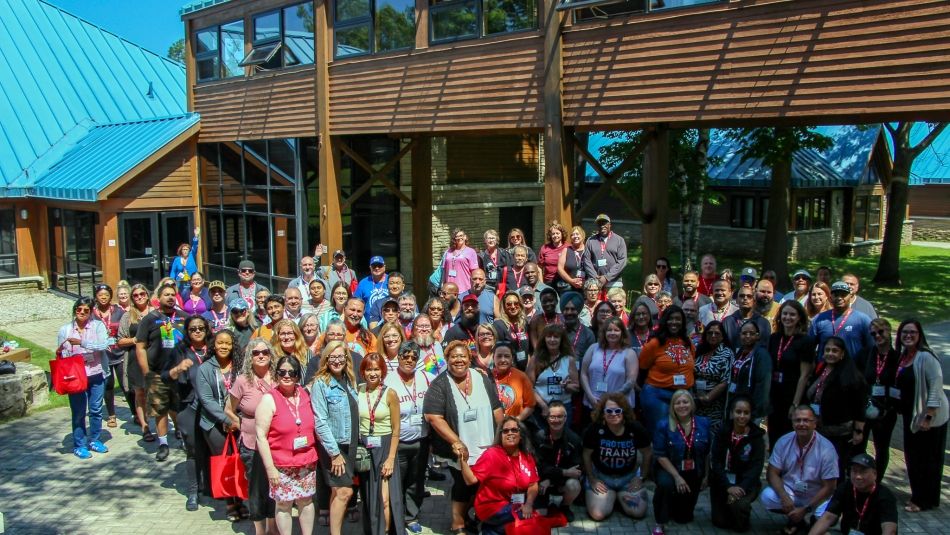
Unifor’s Human Rights Conference brought members to the union’s Family Education Centre in Port Elgin, Ont. for a weekend where delegates and presenters shared stories, built relationships and planned their activism.
Photos from the conference can be seen on Facebook.
“Human rights and union work are inextricably linked. Today, when workers are faced with immense economic challenges and regressive human rights attacks, Unifor members can serve as leaders who refuse to be divided and continue to push for progress for all,” said Unifor National President Lana Payne.
Ontario Regional Director Samia Hashi welcomed delegates to the Centre on Friday evening and framed the fight ahead, “The challenges are real but so is our power and solidarity.”
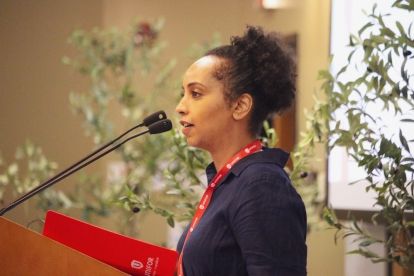
“Every right that we have today exists because workers before us refused to give up. So now it’s up to us to keep up the fight.”
Unifor Atlantic Director Jennifer Murray attended the conference and commented on the caliber of activism present, “This room has some of best campaign organizers, the very people that bring communities together to inspire hope and action.”
Paul Taylor, co-founder of Evenings and Weekends Consulting, addressed the conference and framed the value of human rights as the right to not just a good job, but a good life, and dignity.
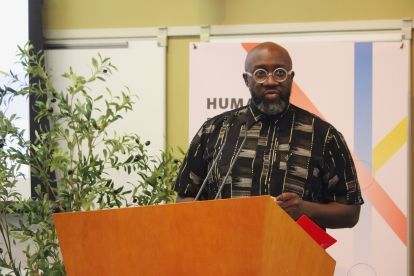
Taylor shared stories of women in his life taking care of one another, and of his own childhood memories of joy, abundance, and love in the kitchen through shared meals and shared solidarity.
“For Black women navigating anti-Black racism, sexism, poverty, and systems that consistently undervalued their lives and labour, choosing joy was an act of resistance.”
“My mother taught me something that I don't think enough leaders understand. Joy isn't what happens after. Joy is a part of how we survive long enough to create justice.”
Delegates took that message of hope into Saturday’s agenda, where Unifor Research Representative Mike Yam hosted a panel of human rights activists who shared the personal importance of their activism.
One panelist, Tawakalitu Braimah of Amnesty International shared her story and told delegates how where you live changes how you identify.
Originally from Ghana, Braimah moved to France before coming to Canada and was faced with contending with a changing identity through these transitions.
“That was my first time being a visible minority. Back home I was a woman before anything else but then in France and in Canada I must see myself first and foremost as Black, because that is the main thing that you see.”
This connection between race, identity and place was echoed by Rabia Khedr of Disability Without Poverty.
“I didn’t know how to identify racism as it was happening to me until I met other people who were experiencing it and we could talk about it. It became real talking to other Muslim women with disabilities,” Khedr shared.
In her decades-long career with InterPares, Rita Morbia has seen that in difficult times, solidarity becomes an obligatory.
During one trip to Sudan, Morbia was in Khartoum when the RSF, which is the paramilitary group, was engaging in an attack and took over the lobby of the hotel where she was staying. The very community she there to support, helped organize her eventual evacuation.
"I experienced profound solidarity from local women, activists, who themselves were facing struggle.”
This experience helped to demonstrate the deep reciprocal relationship in all struggles for human rights.
Jessica McCormick, President of the Newfoundland and Labrador Federation of Labour showed delegates how to lead by example, and with joy.
As the youngest and first out 2SLGBTQIA+ person elected to lead a federation of labour in Canada, McCormick enters all communities and organizing spaces with her whole identity, knowing that sometimes representation does make the world of difference to young or isolated queer and trans workers.
Recently, the NL Federation of Labour investigated the current realities of life for migrant workers in the province which will be addressed in an upcoming government submission.
Immigration program cuts are throwing millions of workers in Canada into deep instability. In the past two years, more than two million people on study and work permits have faced permit expiry while cuts to Permanent Residency are closing doors to a stable life in Canada.
The conferences’ next panel highlighted this current immigration and employment crisis.
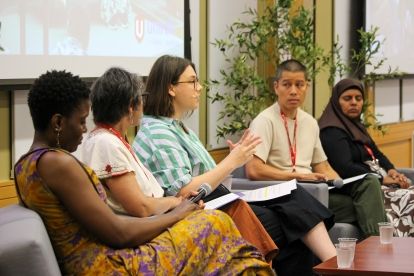
Moderated by Navjeet Sidhu, Director of the International Department and Social Justice Fund, the panel included Danilo De Leon, Migrante Canada, Stacey Gomez, Centre for Migrant Worker Rights Nova Scotia, Deena Ladd, Workers’ Action Centre and Manuel Salamanca Cardona, Immigrant Workers.
Gomez highlighted the advocacy work of the Centre for Migrant Worker Rights Nova Scotia, as well as the ambitious and thorough research the Centre performs.
In the case of Kerian Burnett, the centre directly supported one migrant worker, Kerian who chose to stay in Canada and receive life-saving cancer treatment, while sharing her story and highlight the deep gaps built into immigrant health care coverage in Nova Scotia and in Canada.
Danilo De Leon and Salamanca Cardona also demonstrated the critical pairing of local advocacy with national campaigns in their work.
Sidhu highlighted a normalization of anti-immigrant sentiments and regulations in Canada, Europe and in the U.S.
Deena Ladd agreed, reflecting on the sudden reversal of COVID-era appreciation of migrant, frontline workers, “All of the sudden in 2023 when inflation was huge, and people couldn't find housing then the finger got pointed at international students and migrants. No one was pointing the finger at Amazon and Galen Weston.”
With that frame in mind, delegates moved into workshops on the Rise of the Right and on Unifor’s Protect Canadian Jobs campaign.
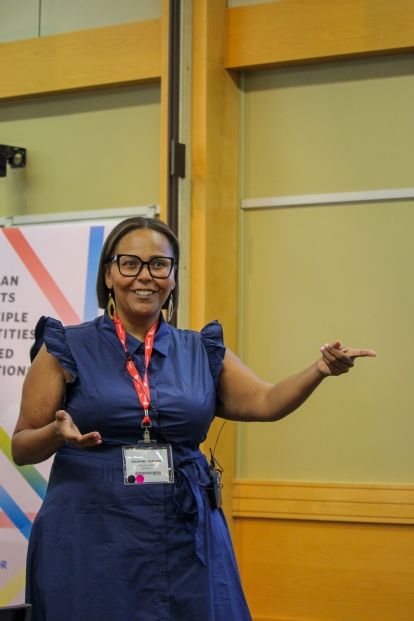
Kassandra Churcher, Executive Director of Amnesty International greeted delegates in the main plenary room after these workshops and delivered an invigorating message of encouragement.
“The human rights movement has a skills problem. But everything that’s missing, you have the skills,” she told delegates.
“How can you use these skills to make the systems change that we know needs to happen? Union hands can build that system.”
Jensen Williams, Unifor Membership Mobilization and Political Action Representative, led a large discussion through Sunday’s panel on Avenues for Human Rights Activism in the Union & Beyond.
Activists from across the union were spotlighted in the session.
Desdemona Lunz, Local 2002 shared her evolution from student to union activist and reflected on the power of Unifor’s member-to-member election campaigns, “volunteering on a campaign is where activism becomes power.”
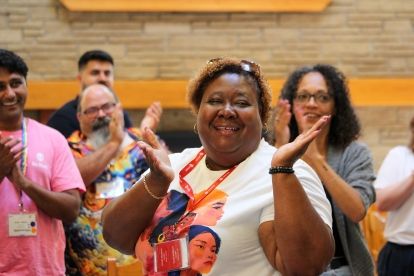
Unifor Equity and Racial Justice Director Tricia Wilson closed the conference with a message of reflection and support for the gathered activists, “As union leaders, our focus must be on identifying systems that can lead to institutional change. As local leaders, that change must happen locally.”
“Our solidarity is our strategy, and it is how we ensure fairness for all.”
National Equity Training
The conference capped off a week of training and strategic planning for the union’s Regional Equity Standing Committees.
Unifor members are elected to standing committees at the regional level to represent members of their equity-seeking communities and lead the union’s equity work.
Together at the Family Education Centre, committee members learned new skills, did research and developed 3-year strategic plans, setting long and shorter-term goals.