

February 29th (February 28th in non-leap years) marks Repetitive Strain Injury (RSI) Awareness Day. As the only “non-repetitive” day of the year, it’s the perfect date to rally together to raise awareness of repetitive strain injuries which are almost always preventable and often go unreported.
RSI Day is a global event and Canada is a leader in the recognition of this special day. We urge all our locals and regional councils to pass this information on to the membership, to shed light on this far-reaching workplace problem affecting our members.
Many Unifor represented workplaces and locals are already involved in events related to RSI day. Please share with us how you celebrate this important day for workers by sending us a message at @email!
What are RSIs?
Repetitive Strain Injuries (RSIs) are an umbrella term describing painful ailments affecting tendons, muscles, nerves and joints due to overuse or misuse. RSIs typically affect body parts like the neck, back, shoulders, elbows, forearms, wrists and hands. Symptoms can progress into chronic and crippling disorders which sometimes cannot be reversed or corrected, no matter the amount of physiotherapy or surgery. RSIs are also known as musculoskeletal disorders (MSDs) and result in the highest frequency of lost-time injuries in Canada.
Examples of RSI injuries include:
- tendinitis
- bursitis
- neuritis
- epicondylitis
- arthritis
- muscle strain
- low-back injury
- herniated disk
- carpal tunnel syndrome
Common symptoms can range from mild to severe and usually develop gradually, including:
- throbbing
- aches and pains
- tenderness
- burning
- tingling
- stiffness
- loss of joint movement and strength in the affected area
- numbness
- swelling
- weakness
- cramps.
The Hierarchy of Controls
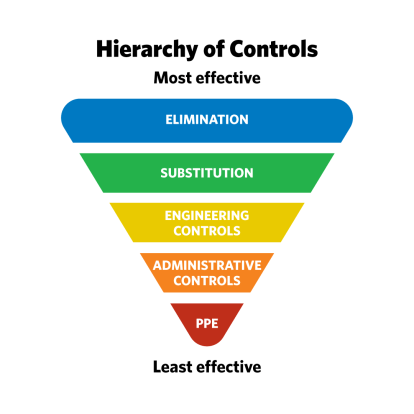
Hazards are best eliminated at their source. This also applies to ergonomics. The prevention of RSIs begins with eliminating repetitive work through job design. That may involve varied interventions, ranging from product substitution, automation or engineering controls to personal assist lifting devices like hoists or tools. All tools and equipment should be properly sourced and maintained. Well designed workstations should be adjustable to fit the worker.
What We Can Do as a Union
- Ensure all repetitive strain injuries are reported to the employer, as soon as early symptoms arise
- Educate workers about RSIs
- Bargain ergonomic related language into our collective agreements
- Use the collective agreement language we have as a tool for the improvement of ergonomic conditions in the workplace
- Use general duty clauses in Occupational Safety and Health legislation to make recommendations for improving jobs that are problematic or causing injuries
- Demand that jobs that hurt workers are “fixed” with tools, equipment, changes in process, additional help and other methods
- Follow up and evaluate successes of implemented controls
- Encourage workers to take time to rest away from the source causing the RSI and force employers to offer lighter duty work until workers are healed
- Ensure that RSI related issues are discussed at health and safety committee meetings
- Involve the federal or provincial ministries of labour or WorkSafe organizations in your jurisdictions when you feel that the employer is not responding favourably to your requests to improve poor jobs causing RSIs
International Repetitive Strain Injury Awareness Day was established by local injured worker activists on the initiative of Catherine Fenech, in 1998. Catherine was an injured young worker who was a member of an international group of workers looking for recognition of their workplace injuries. We invite you to learn about the history of RSI Day through this link to OHCOW’s YouTube page.
Catherine’s activism began through petitions, moving to demonstrations and press conferences at local government offices over a period of years in the early 2000’s and by the end of that decade, these types of injuries were being debated in government subcommittees and panels – of course, employers’ groups were not at all interested in promoting or discussing this issue. We still find that many employers are painfully unaware of the importance of ergonomics in the planning and execution of the jobs that our members do.
We are here to help…
The Unifor National Health, Safety and Environment Department is always available and willing to support local unions and their workplace safety committees in all aspects related to health and safety, including ergonomics and repetitive strain injuries prevention.
For more information on RSI Day or workplace ergonomics contact the Unifor National Health and Safety Department at (800) 268-5763 / 416-497-4110 or @email.