

Share
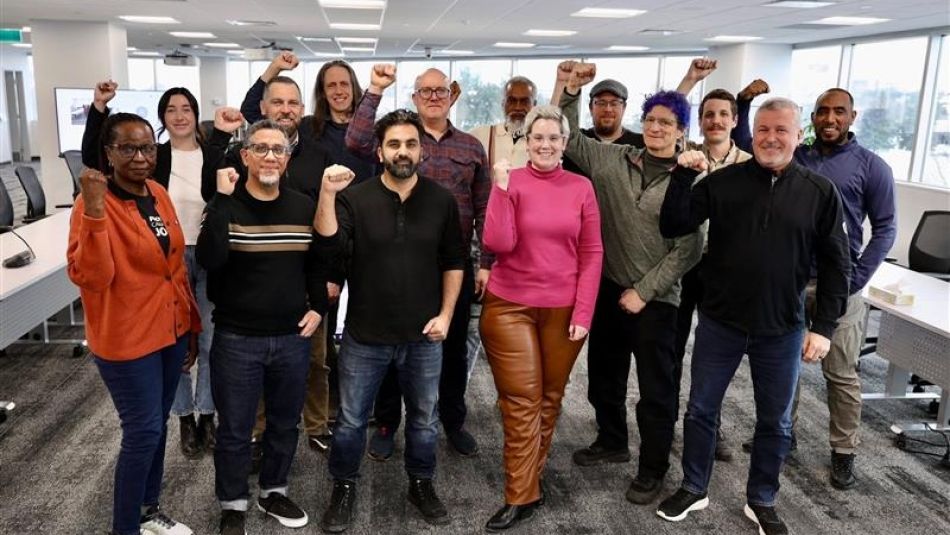
Amazon warehouse workers from Coventry, United Kingdom, joined Unifor organizers on Feb. 5 at the union’s national office in Toronto to exchange lessons, strategies, and hard-won insights from efforts to organize one of the world’s largest employers.
The meeting brought together Amazon workers, Unifor staff, activists from the United States, and organizers from GMB for an international discussion focused on organizing tactics, worker safety, and building global solidarity against what participants described as Amazon’s increasingly influential labour model.
“This fight isn’t just about Amazon,” said Unifor Organizing Director Justin Gniposky.
"It is about the future of work and workers rights to freely and fairly access unions here in Canada and internationally under out respective laws."
The discussion followed the closely watched 2024 organizing drive at Amazon’s Coventry fulfilment centre, where workers organized with GMB to secure statutory union recognition that would have required Amazon to bargain over wages and working conditions.
In a narrow loss in a legally mandated ballot overseen by the Central Arbitration Committee, the union fell just short of the threshold for recognition.
Under U.K. labour law, GMB is now barred from re-applying for statutory recognition at the site for three years, effectively pausing legally enforceable bargaining until that period expires. However, hope remains.
“If we all fight together, it’s going to impact workers across all sectors and systematically break the business model Amazon has created,” said GMB organizer Ferdousara Uddin, who joined the meeting virtually.
Participants identified common barriers to organizing Amazon, including high turnover, long shifts, language barriers, worker fear, and aggressive anti-union tactics. Health and safety emerged as a central concern for warehouse workers in general.
“We hear time and time again the horrible stories,” said Unifor National Representative Angela Drew Kimelman.
“One worker had a 1,200-pound pallet fall on him and can no longer walk. It took that injury for the company to start checking pallets.”
Others pointed to Amazon’s use of algorithmic management and surveillance as part of a broader shift in how work is controlled.
“Ninety years ago, capitalists looked to companies like General Motors and steel as model employers for perfecting productive efficiency, worker exploitation, profit extraction,” said Jonathan Rosenblum, activist in residence at the Centre of Working Democracy at Arizona State University.
“Today, Amazon is the trailblazer.”
Several speakers highlighted the vulnerability of immigrant and temporary workers, who often face language barriers and fear retaliation or immigration consequences.
“There is a language barrier where they cannot even express what they are feeling,” said Mohamednur J. Mohammed, Amazon Workers Branch Auditor and Representative.
“Majority of our families back home depend on us. And Amazon is well aware of that. That’s why they exploit us. They know we’re not going anywhere and why the abuse comes day after day. It has to stop.”
Unifor was certified to represent Amazon workers in Delta, B.C. in July 2025 and is currently in collective bargaining.
Gniposky said Amazon’s tactics in Canada mirror those used internationally, including rapid hiring during organizing drives and messaging aimed at dividing workers.
Despite the challenges, participants said the meeting itself demonstrated the power of cross-border organizing.
“We need to see this as a global fight,” said Garfield Hylton, a Coventry worker since 2018 who became the GMB Amazon Workers Branch Secretary and Representative during the organizing campaign.
Coordinated international solidarity days, shared multilingual organizing calls, and worker-to-worker exchanges between Amazon facilities in different countries, cross-border solidarity and coordinated pressure—paired with legal, political, and media strategies—are key to countering Amazon’s model and building durable worker power.
Unifor representatives said the union plans to deepen international worker power as bargaining continues in British Columbia and organizing expands elsewhere.
“This is about more than one warehouse or one country,” Gniposky said.
“If we let [Amazon] get away with union busting at this scale, it’s only so long before they sell that ability to every employer.”