

Share
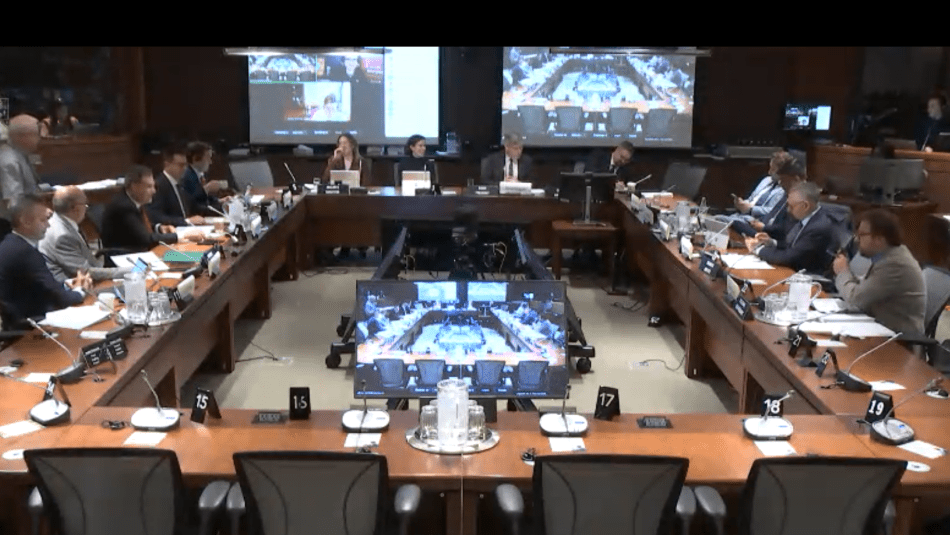
Unifor National President Lana Payne urged the House of Commons Standing Committee on Natural Resources today to put energy workers at the centre of Canada's plan to become an energy superpower, warning that aging infrastructure, "run-to-fail" maintenance strategies, and shrinking domestic capacity are putting the country's energy security at risk.
Speaking on behalf of Canada's 15,000 Unifor members in oil and gas extraction, natural gas distribution, electric utilities, refineries, chemical production, and nuclear energy, Payne told MPs that industry profits are not translating into jobs, investment, or safer infrastructure on the ground.
"I hear it across the political spectrum. Politicians say they support energy workers. But we don't see that translating to the shop floor," said Payne. "We see outsourcing, sub-contracting to non-union work, and automation, all while infrastructure is pushed to its limit. Canada cannot be an energy superpower if we keep running our energy infrastructure to the point of failure."
Payne told the committee that Unifor supports reducing Canada's export dependency on the United States and backs the safe, well-regulated movement of energy products through pipelines, rail, and marine transport. But she cautioned that diversifying exports cannot come at the expense of domestic refining, chemical production, and downstream capacity.
She pointed to a string of recent setbacks, including the closure of INEOS in Sarnia and Biox in Hamilton, and delayed investment from Shell and Dow Chemical, including a $9-billion petrochemical project in Fort Saskatchewan pushed back by two years.
"Without domestic capacity for refining, chemical, and plastic production, Canada is simply subsidizing the energy superpower to the south," Payne said. "We're off-shoring production while our own pipelines and downstream infrastructure are left to deteriorate. That's not energy resilience. That's the opposite."
Payne described the production and export side of the industry as a "money printing machine" for shareholders, while as little as possible is spent on workers and maintenance or building new capacity.
She used her testimony to highlight Unifor's Keep it in the Pipe campaign, which calls out run-to-fail strategies and pushes for investment in the energy workers who maintain midstream and distribution infrastructure and reduce methane and chemical leaks.
Payne also stressed that CANDU nuclear technology must be part of Canada's plan for a resilient and secure energy system.
"Building a stronger, more resilient Canadian economy starts with building more energy and, above all, investing in energy infrastructure and the workers who maintain it and keep it safe," Payne said.
Watch the prepared remarks or the entire testimony to the committee.