
Share
MONTREAL – Unifor members at the Domtar mills involved in Eastern Canada pulp and paper pattern bargaining have voted in favour of the conciliator’s settlement recommendation presented by the union earlier this week.
This vote formally sets out the terms of the new pattern agreement, which will serve as a model for future negotiations in the pulp and paper in Eastern Canada.
The agreement comes at a particularly critical time for Canada’s forestry industry. For several months, the sector has borne the brunt of the trade war with the United States, the rise in tariffs imposed on Canadian forestry products, and a series of slowdowns, production shutdowns and layoffs that have made workers, their families and entire communities more vulnerable.
“Forestry workers are the victims of a trade war they did not start,” declared Unifor national president Lana Payne. “The situation is urgent, and the response must be commensurate with the challenges facing the industry. We need to take collective action to protect jobs, keep our mills running and ensure that the workers who have built this industry have a place in its future.”
The vote by members comes on the heels of three rounds of intense negotiations between Unifor and Domtar, the employer targeted in this round of pattern bargaining. Faced with an impasse at the negotiating table, the parties agreed to put the conciliator’s recommendation to a vote by the members. The union presented the contents of the recommendation to members at the three mills for a decision. Failure to reach an agreement would have resulted in an immediate labour dispute.
“We cannot look at these negotiations without considering what is happening in the wider industry,” said Daniel Cloutier, Unifor’s Quebec director. “Bargaining took place in the midst of a trade war, at a time when mills are scaling back or closing and thousands of workers are facing significant uncertainty. Against this backdrop, after careful consideration, our members made a choice to protect their hard-won gains, secure improvements and establish a pattern agreement that allows us to continue moving forward. This model will now serve as the benchmark for bargaining across the rest of the sector.”
The four-year agreement, in effect from May 1, 2026 to April 30, 2030, provides for annual pay increases of 2.5%, for an overall total of 10%, plus an annual attendance bonus of up to 1%. It also offers improvements to vacation and leave, as well as gains relating to group insurance, the pension plan and the probationary period.
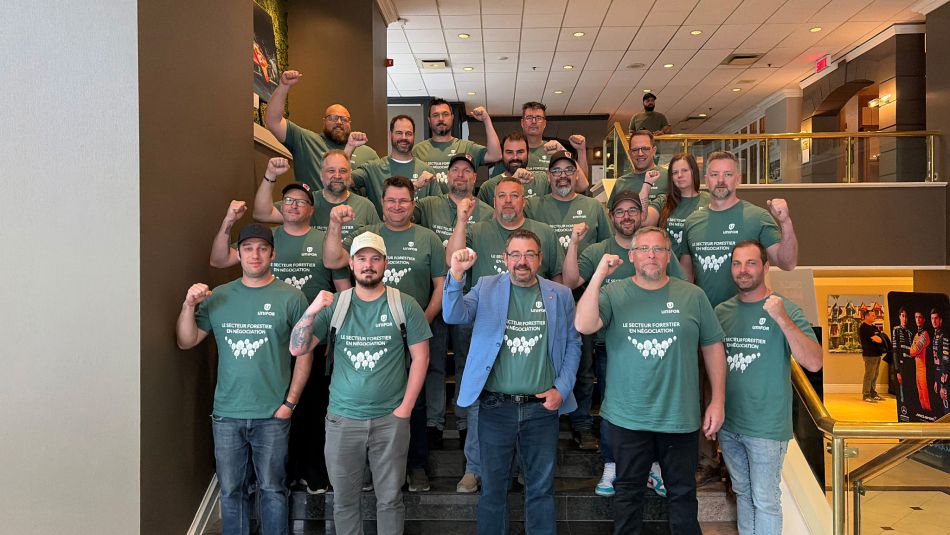
“These negotiations were difficult from start to finish, but our committee was determined to defend the priorities established by the members. The pattern contract is now in place, but our work is far from over. Our achievements at the bargaining table will serve as our starting point for future negotiations, and we will continue to fight to improve working conditions across the entire sector,” said Martin Dugas, forestry sector coordinator for Unifor Quebec.
Having established this new pattern agreement, Unifor will now turn its attention to the next stages of its coordinated bargaining approach across the industry. The union will first continue negotiations in the sawmill sector, before moving on to the other sectors of the forestry industry.